
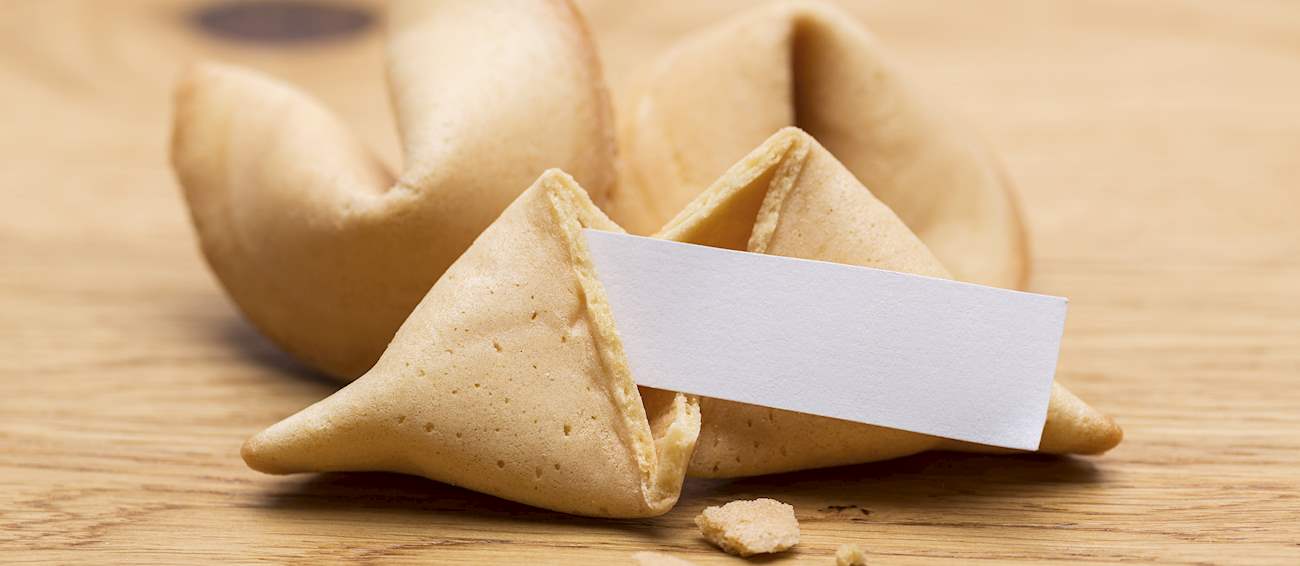
The intriguing fortune cookies are crispy folded wafers hiding an entertaining “fortune” inside. The “fortune” is a written note; a proverb or a universal prophecy believed to predict the person’s future. The cookies are made with egg whites, flour, sesame oil, and sugar, and have a slight vanilla flavor.
They are rolled in flat, perfectly round shapes, then baked. Before they are folded, when they are still hot and pliable, the written fortune is nestled inside the cookie. As they cool, the fortune cookies harden and achieve their distinctively crunchy texture.
Even though they are usually associated with Chinese restaurants, where they are served at the end of the meal, their origin is believed to be hidden in the Japanese culture. They are closely associated with o-mikuji, the Japanese tradition of placing fortunes at Buddhist and Shinto temples and are somewhat similar to Japanese cookies tsujiura senbei, which are slightly larger and darker in color.
The origin of the westernized fortune cookie is vague, but it is believed it primarily appeared in California at the beginning of the 20th century. It is still disputed whether it was invented in Los Angeles by a Chinese immigrant David Jung, the founder of the Hong Kong Noodle Company, or in San Francisco by a native Japanese Makoto Hagiwara, a gardener who designed the Japanese Tea Garden.
Today, most fortune cookies are produced in the United States, with the biggest factory located in Brooklyn. They constitute an important part of American culture and Chinese-American cuisine. Outside the United States, they can be found in numerous Chinese restaurants around the world, but are rarely found in China.